

Launching Academic Partnerships

In February 2026, we officially launched the Polaron Academic Partnerships scheme.
We are providing early access research licences, cloud resources, and collaboration opportunities for our platform to leading universities and laboratories to advance the state of the art in materials intelligence. With Polaron you can:
- Automate microstructural analysis from image data
- Reconstruct realistic 3D structures from 2D images
- Explore design spaces in silico before running experiments
- Share models and results across teams
Polaron spun out of my research group at Imperial College London, where I still spend most of my days as a Professor of AI for Materials Design. My perspective on what Polaron should be is shaped largely by the time spent in the lab with PhD students, wrestling with microscopy images, and trying to make sense of messy data.
When we talk about "AI in materials science," the conversation is often dominated by the idea of AI as a "bolt-on" - i.e. a clever trick you apply at the end of a project to make a graph look more impressive for a paper.
At Polaron, we have a different thesis. We believe materials science is entering a period of structural change where research becomes AI-native. This partnership scheme is our way of working with the teams around the world who are actually going to implement that future.
The high cost of the "Status Quo"
If you’ve worked in a materials lab recently, you know the frustration of the current workflow. It is slow, manual, and often uncomfortably fragile (i.e. not reproducible).
A typical pipeline today is a bit of a Frankenstein’s monster: you collect images, manually segment them (often spending hours on a task an algorithm should do in seconds), export them to a reconstruction tool, move them again to a simulation suite, extract some metrics into a spreadsheet and finally try to stitch it all together into a story.
Because these steps are fragmented, uncertainty doesn't propagate. If your segmentation is 1% off, how does that affect your predicted battery cycle life or the structural integrity of your alloy? In the current manual workflow, answering that is nearly impossible.
Furthermore, the "compute problem" in academia is a constant headache. I’ve seen it many times (including in my own team): a group buys a moderately powerful workstation with a grant, it’s a nightmare to maintain, and it sits collecting dust 90% of the time because the software environment is broken or the student who knew how to run it has graduated, when it is running, it’s nowhere near as good as those available in the cloud.
One of the core beliefs we hold at Polaron is that we aren't extracting nearly enough information from our measurements. This is most obvious in imaging.
Consider the math of characterization. You can collect a representative 2D SEM image in about 30 minutes. To get a representative 3D volume using FIB-SEM slice-and-view, you’re looking at days of machine time. That is a two-order-of-magnitude difference.
For a long time, we just accepted this "3D tax" as the price of doing business. But in 2026, that trade-off no longer makes sense. (X-ray imaging can be faster, but it generally doesn't have the resolution or phase segmentability necessary for battery electrodes).
Five years ago, we published the SliceGAN method, which was our first real attempt to reconstruct 3D microstructures from 2D data. It was a start, but it had its flaws. Since then, the world of generative AI has moved on massively and Polaron’s latest 3D generation models are radically more accurate and robust than sliceGAN - it’s really exciting to get to share what we’ve built.
Using AI to generate microstructure turns out to not just be more accurate than physics-based models, but also orders of magnitude faster! In our recent paper in Matter, we demonstrated how this allows us to build the models directly into closed-loop optimisations based manufacturing parameters rather than things like tortuosities (which can’t be directly controlled with a dial in the factory).
When you can turn a 30-minute SEM image into a statistically representative 3D volume in seconds, you aren't just doing the same science faster - you’re doing different science entirely. You can explore design spaces in silico that would have taken years to probe experimentally.
Who cares about microstructure anyway?
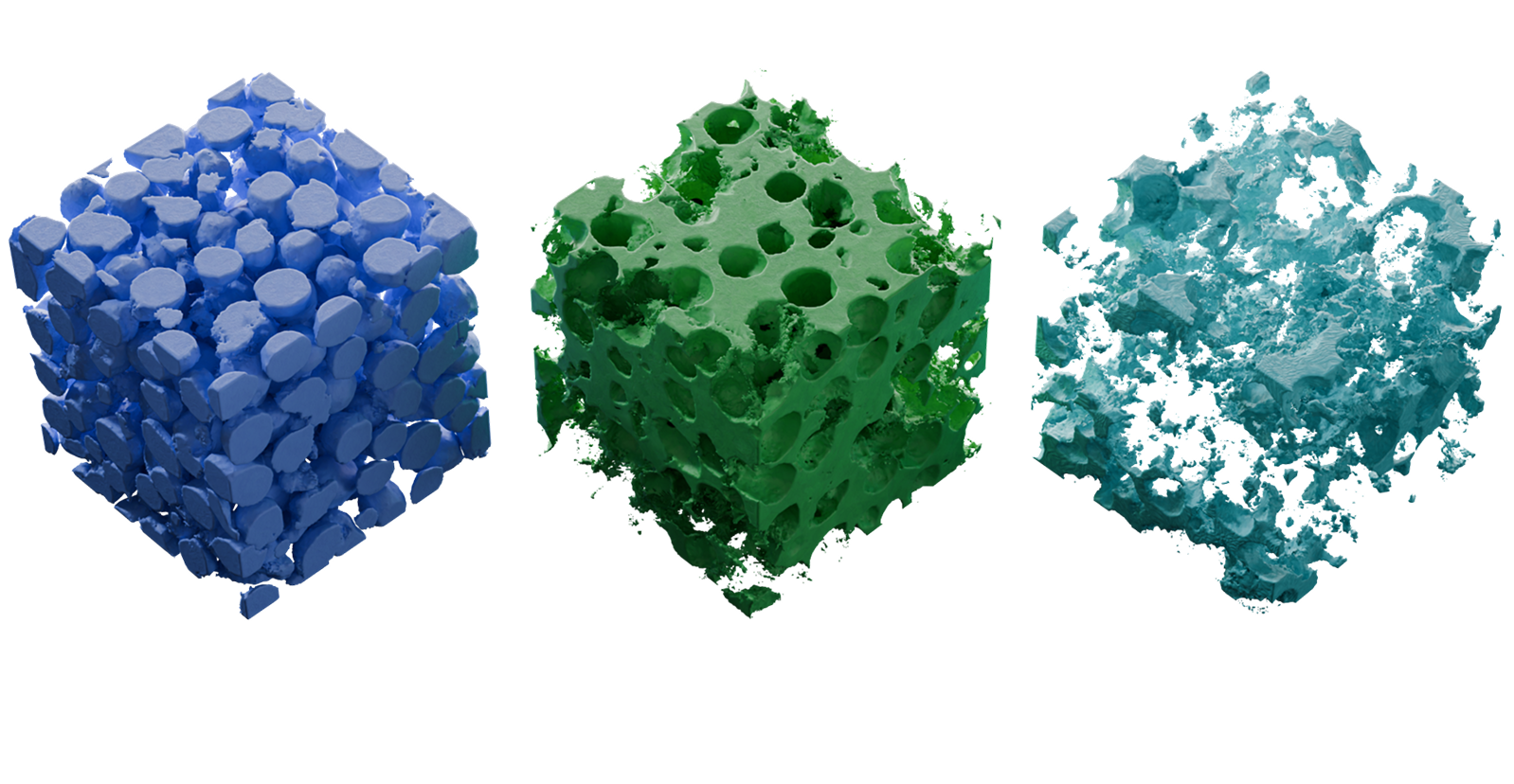
Basically every material has microstructure and it hugely impacts material properties. You can think of it as the in between length scale - the bridge between chemistry and CAD. Considering this, we think that microstructure is an astonishingly underserved area of research. Huge investments have recently been made into companies using AI to accelerate design at the atomic scale (e.g. CuspAI) and at the mm scale (e.g. PhysicsX). This is very exciting to see, but as all you microstructure fans know, our scale requires some quite distinct considerations.
When designing chemistry, atoms are your fundamental building blocks and they have well defined properties that, once calculated, are true (even if you can’t always synthesise what you predict). When designing at the mm scale, you can essentially specify nearly any design and you’ll be able to machine/print/cast/forge them. These represent two very important and very distinct design paradigms… but we think there’s a third entirely distinct domain hiding between these two:
The microscale (for most materials) is fundamentally stochastic in nature… This means that even if I found an ideal arrangement of particles for a battery electrode (for example), I can’t just specify the position of each atom, nor can I submit a CAD model to my CNC machine to make it… instead, I need to control this microstructure indirectly, using manufacturing parameters like pressure and temperature. The relationship between these parameters and the resulting microstructure is hugely complex and has to be approached from a statistical point of view… which is why its so well aligned with the latest AI methods!
Why we want to partner with you
This brings me to the "Academic Partnerships" scheme. Why are we doing this?
Quite simply, we want to solve the hardest problems in the field, and academics are the best at finding them. We aren't just looking for "users"; we’re looking for collaborators who will push our platform until it breaks.
We’ve already seen a fantastic range of partners sign up, covering everything from:
- Electrolysers and Carbon Capture (the front lines of the energy transition).
- Pharmaceuticals (where microstructure defines drug delivery).
- Concrete and Structural Alloys (where scale and reliability are everything).
- Batteries (our home turf).
Unlike standard software trials, we are getting in the trenches with these teams. We want to understand the specific pain points of a researcher working on a new structural composite just as much as someone working on solid-state electrolytes.
Academics are also uniquely keen to share their progress. We want to see our partners publish. We want to see the "Polaron-native" workflow in the pages of the top journals and industry publications, showing how a systematic, cloud-managed, and traceable approach leads to discoveries that were previously buried in the noise of manual analysis.
The future of materials research is one where the loop between data, insight, and decision-making is dramatically shortened. It’s a future where your compute is managed in the cloud, your models are shared seamlessly across your team, and your 2D data is treated with the richness it deserves.
If you’re a PhD student tired of manual segmentation, or a PI who wants to move their group toward a more reproducible, AI-native workflow, I’d love for you to join us.
We are selecting a small number of partners for this first cohort. If you’re pushing the boundaries of what materials can do, let’s see what we can discover together.
Dr Sam Cooper
Associate Professor in Artificial Intelligence for Materials Design in the Dyson School of Design Engineering
Chief Scientist at Polaron